Tags: blog, film, documentary, recommended, 2026
Author: KickingK
Date: Tuesday October 20th, 2026
My God, It's full of sheep
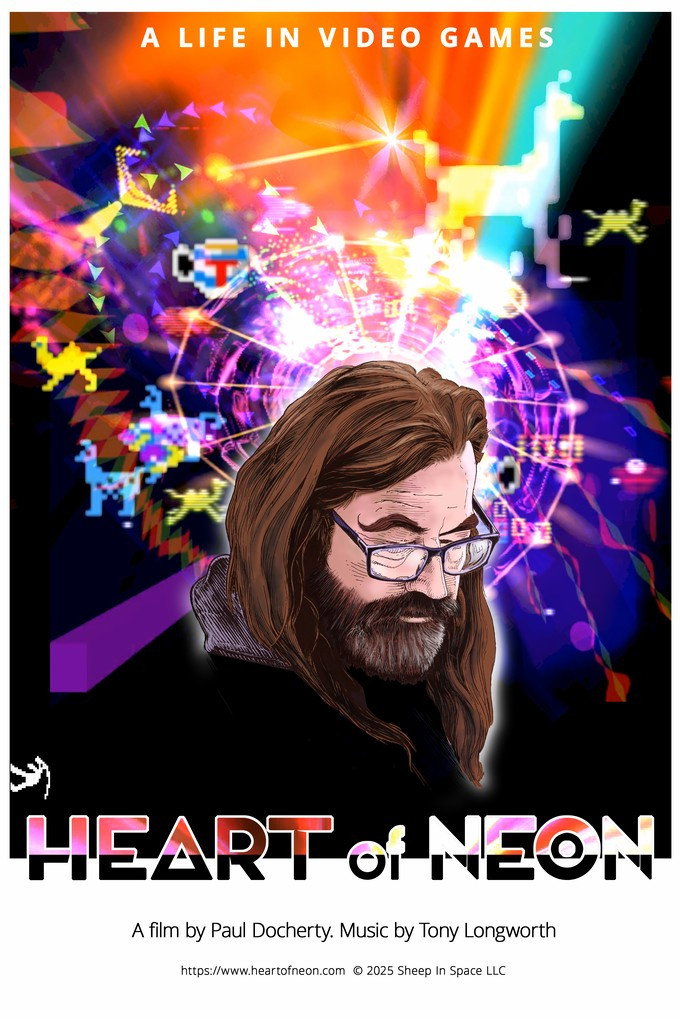

I remember the eighties and the things I remember most vividly about it are the computer games. And they weren't like how they are presented through mainstream retro gaming culture. That's all talk of the 'great video game crash', arcade games, Mario Bros' coin sound effects, NES, CGA & VGA palettes.
But almost none of that happened in the UK. We had computer games, not videogames. Arcades existed but were expensive and therefore a rare treat. NES and PC's were the toys of the rich kids. Our palettes were the garish clash of the Spectrum or the muted muds of the Commodore. Our sound effects started as synthwave and ended up creating the entire musical genre of rave and jungle.
This is because computer games in Britain started not as a money making scheme but as a hobbyist scene. The first home computer to really explode was the ZX80, which you could buy for just shy of a ton. Or a score cheaper if you bought it as a kit and soldered it together yourself. Which a lot of people did.
The ZX80 kickstarted the computer game industry in this country, which means that it was started not by corporations with dollar signs in their eyes, but by people prepared to solder their own computers to save a couple of Ayrton's.1
And those people, and I mean this in the most complimentary way possible, are not normal. They made computer games because they wanted to see what was possible and they took inspiration from what ever was around them.
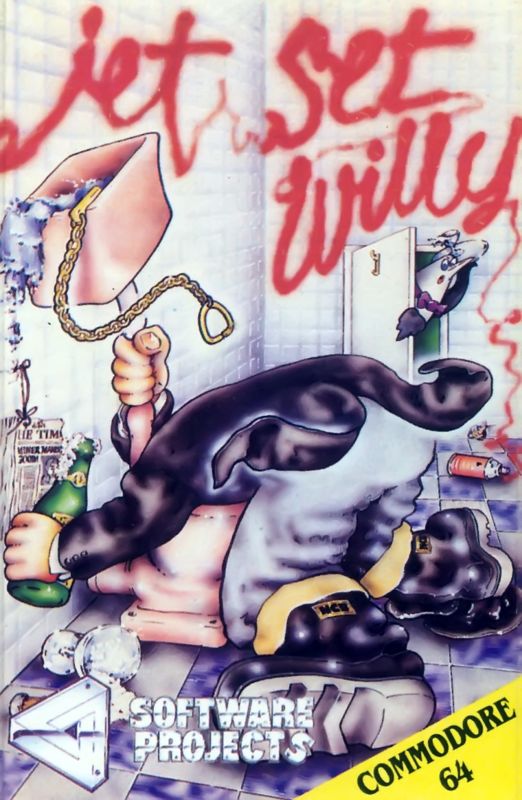
This resulted in the biggest selling computer game from 1984 being about a man trying to clean up his mansion after going on a massive bender. The box art looked like this.
And the game looked like this.
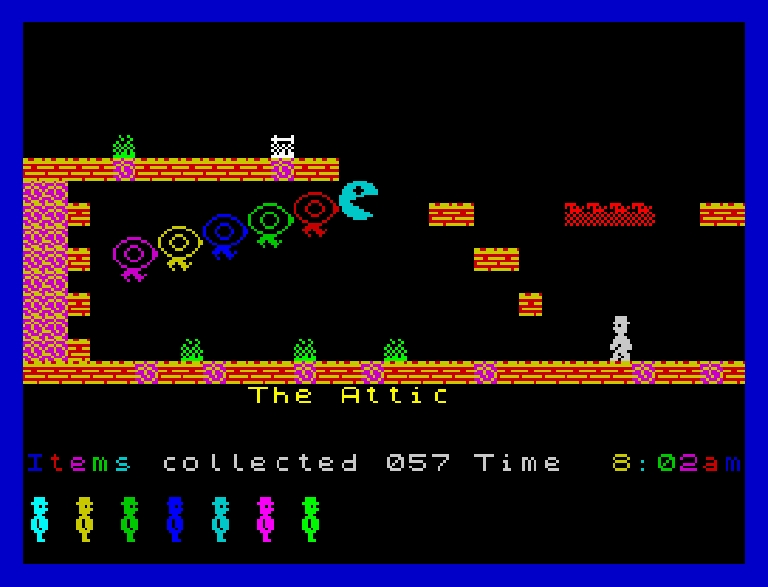
This isn't some wild aberration, this was par for the course. This is what happens when gaming culture is created by teenagers reared on Monty Python, It's a Knockout, Spike Milligan and Viz.
This is where the subject of Heart of Neon, Jeff Minter, hails from. Jeff made some of the greatest games of the 8-bit era. Laser sharp arcade games with tons of imagination, ludicrously bright colours and all kinds of bonkers particle and strobing effects. And he filled most of them with his favourite ungulates.
He then went on to make some of the best games of the 16-bit era, all filled with bonkers particle effects and a host of sheep, camels, llamas and goats.
He then made some of the greatest games of the 32-bit era...you get the picture. Pick an era of computer/video games and Jeff was there making the best arcade games and packing them with sheep and camels. And he's still going.
This documentary is his story. And as it's an indie, crowdfunded documentary, it's a story mostly told by his friends, fans and the occasional industry colleague.
This is perfectly fitting for Minter. In a games industry that has relentlessly become more corporate and commercial, he's always stood out as personable and independent. Something that is obvious any time you hear him speak or play his unique games. So hearing how warmly he's regarded by the people who know him best really brings out the humanity of him.
However, for me, this doesn't quite do justice to Llamasoft's achievements. I would have liked the documentary to be a bit more ambitious. To tell Llamasoft's and Jeff's story in parallel to a history of the British software industry. To be fair, it does talk about this, but it's not the focus of the film. It's there to give colour to Jeff's story, rather than the narrative thrust that I personally think it should be. Because I think that's the only way to explain what Jeff means to those of us who had Spectrums or C64's in the eighties.
It's not just that Jeff has survived all this time. It's not just that he's made some of the best games in every generation2. It's not just that he's the only one who's stuck to being a tiny one or two man independent the whole time. It's not the fact that he's still at the cutting edge of what a video game can be. And it's not even the fact that he's still making games with sheep and camels and llamas and goats in.
It's the fact that Jeff is literally a one-man, unbroken line, going right back to the birth of the UK games industry.
We're currently living in a time where a video game is about to become the most expensive entertainment product ever but the indie/hobbyist scene is as weird and experimental as it was in the eighties. The industry has bifurcated to the point that the two ends of the spectrum barely recognise each other anymore. One wants to re-write history for it's own commercial gain, whilst the other is too young to remember or celebrate that history.
Consequently, outside of a few kickstarters and a few magnificent websites, there's hardly anyone pushing a genuine celebration of the UK eighties computer games industry. Step into a retro games shop anywhere in Britain and you won't find any mention of Chuckie Egg, Caesar the Cat, Horace or Corleth the Fey. You'll be lucky to find a Quickshot 2, despite all of these being ubiquitous at the time.
And yet a new LLamasot game has the same feel now as it did back then. Trying to get your head around Akka Arrh has the same 'patting your head whilst rubbing your stomach whilst solving a cryptic crossword' feel that Iridis Alpha had. You'll grit your teeth and fight for your life as much in Tempest 4000 as you did in Gridrunner. And you'll delight in the sheep and llamas and camels in all of them. None of it quite makes sense, it's all so bloody weird, and yet it all just works.
Under the weight of corporatised and commercialised nostalgia for IP friendly franchises, the continued existence of Llamasoft is an irrefutable reminder that the early UK games industry existed and it was bloody glorious.


Poster Credit Available to purchase
1. Yes, I am doing this on purpose.
↩
2. Good lord, where do you even start with a favourite LLamasoft games? For me it's Tempest 2000, Iridis Alpha, TxK/Tempest 4000, Attack of the Mutant Camels (A game that dared you to fly as close as you can to a camel's arse without being spat at to death) & Gridrunner (any version).
↩